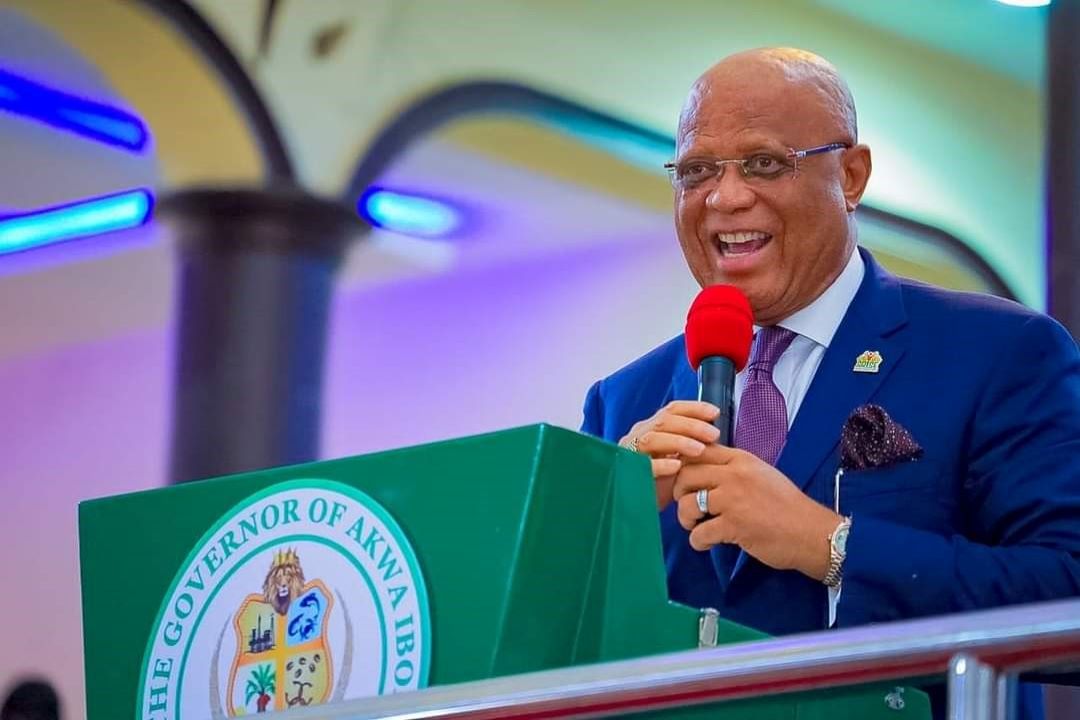
Before he became the Governor of Akwa Ibom State, Umo Eno says he was already making millions from a humble Nigerian favourite — akara and bread.
The Governor revealed that his akara business once generated nothing less than ₦10 million every month, offering a surprising glimpse into his entrepreneurial journey before politics.
Eno made the revelation during the state’s monthly covenant prayer service on Tuesday, with the video of his remarks subsequently gaining attention online.
According to the governor, his business journey started with the sale of akara and bread, which he creatively packaged and marketed as “Akara Burger.”
The concept was simple: bread was opened up and filled with akara, giving customers a convenient breakfast option.
“I started selling akara and bread. Back then, I was doing Akara Burger. We open the bread and put it inside for you.”»
The business eventually expanded into a coffee shop, with Eno recalling that workers, particularly those heading to ExxonMobil, became regular morning customers.
“People going to ExxonMobil will buy it in the morning, take coffee.”
Then came what could arguably be the most eye-catching part of his story.
“Every month, that akara business used to give me nothing less than ₦10 million in a month.”
Eno’s revelation has sparked renewed interest in the earning potential of Nigeria’s informal and small-business sector.
The governor said his experience running the venture gave him valuable lessons about entrepreneurship and the importance of starting small, serving customers and gradually expanding a business.
His story is particularly noteworthy because it comes amid a national debate over whether small-scale businesses can provide Nigerians with sustainable sources of income.
Earlier this year, First Lady Oluremi Tinubu drew significant attention after encouraging Nigerians to explore small businesses such as akara, roasted corn and kuli-kuli as possible avenues for improving livelihoods.
Speaking after a Renewed Hope Initiative meeting with wives of state governors in Abuja, she explained that some of the ventures could be established with relatively little capital.
The comments triggered a fierce social-media debate, with critics arguing that the cost of doing business and Nigeria’s wider economic challenges make it difficult for many petty traders to thrive.
The First Lady subsequently clarified that the empowerment programme was broader than akara businesses, explaining that tomato sellers, roasted plantain sellers, pepper traders and vegetable sellers were also included.
She also announced a ₦100 million intervention for 2,000 petty traders in Jigawa State, with each beneficiary receiving ₦50,000 as a grant to recapitalise their businesses.
President Bola Tinubu later added a humorous twist to the controversy, referring to his wife as “Iya Alakara” during a Presidential Press Corps Dinner.
For Eno, however, akara was apparently more than just a roadside food business.
His account presents it as an early entrepreneurial venture that eventually expanded into a coffee shop and provided him with experience that he says shaped his understanding of business.
And while his reported ₦10 million monthly earnings are exceptional compared with the experience of the average small-scale food vendor, the story has once again put the spotlight on the possibilities that can emerge when a simple product is turned into a properly organised business.
Eno’s story is a reminder that some business journeys can begin in the most unexpected places.
About The Author